KCMC University Danida Supported MSc Scholarship in Immunology and Inflammation 2027 2029
KCMC University Danida-Supported MSc Scholarship in Immunology and Inflammation 2027-2029
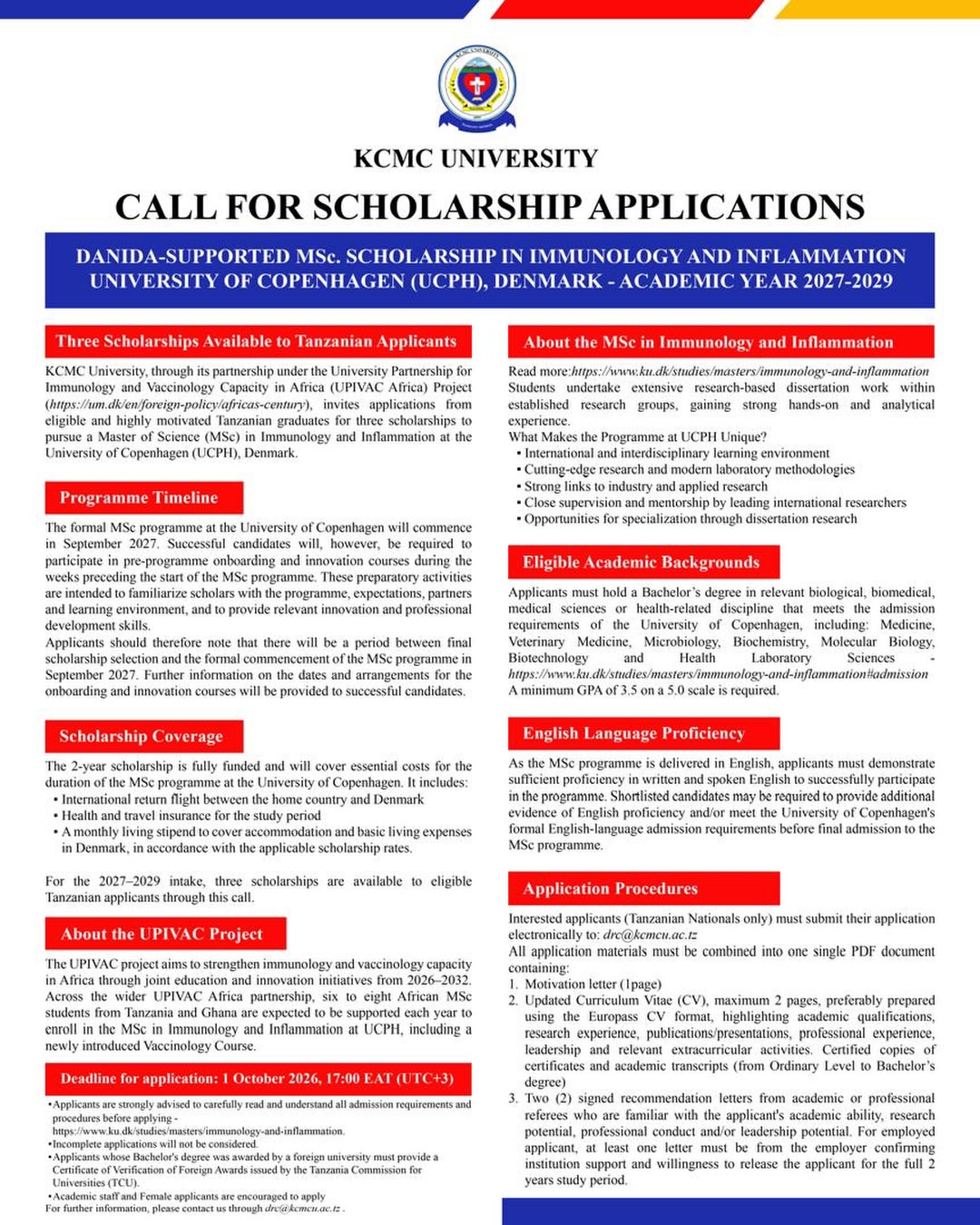
KCMC University has announced a call for scholarship applications for Tanzanian graduates interested in pursuing a fully funded Master of Science (MSc) in Immunology and Inflammation at the University of Copenhagen (UCPH), Denmark. The scholarship is supported through the University Partnership for Immunology and Vaccinology Capacity in Africa (UPIVAC Africa) Project and is available for the 2027–2029 academic period.
A total of three scholarships are available to eligible Tanzanian applicants. The two-year scholarship will support successful candidates throughout their MSc studies and will provide financial assistance for essential study and living costs in Denmark. The formal MSc programme is scheduled to begin in September 2027, although selected scholars will participate in preparatory onboarding and innovation activities before the programme starts.
Scholarship Benefits
The Danida-supported scholarship is fully funded for the two-year MSc programme and includes:
- International return airfare between Tanzania and Denmark.
- Health and travel insurance for the study period.
- A monthly living stipend to support accommodation and basic living expenses in Denmark, in accordance with the applicable scholarship rates.
- Pre-programme onboarding and innovation courses before the formal commencement of the MSc programme.
- Access to an international and interdisciplinary academic environment at the University of Copenhagen.
- Research and professional development opportunities through the UPIVAC Africa partnership.
About the UPIVAC Africa Project
The University Partnership for Immunology and Vaccinology Capacity in Africa (UPIVAC Africa) Project is designed to strengthen immunology and vaccinology capacity across Africa through joint education, research and innovation initiatives.
The wider UPIVAC Africa partnership is expected to support approximately six to eight African MSc students from Tanzania and Ghana each year to study Immunology and Inflammation at the University of Copenhagen. The programme also includes a newly introduced Vaccinology Course aimed at strengthening specialized knowledge in this field.
About the MSc in Immunology and Inflammation
The MSc in Immunology and Inflammation at the University of Copenhagen provides students with advanced knowledge and practical experience in immunology, inflammation and related biomedical research. Students undertake extensive research-based dissertation work within established research groups, allowing them to develop strong laboratory, analytical and scientific research skills.
The programme offers:
- An international and interdisciplinary learning environment.
- Exposure to advanced research and modern laboratory methodologies.
- Strong connections with industry and applied research.
- Close supervision and mentorship from leading international researchers.
- Opportunities to specialize through dissertation research.
- Practical experience in research environments relevant to immunology and inflammation.
Eligible Academic Backgrounds
Applicants must be Tanzanian nationals and hold a relevant Bachelor's degree that meets the admission requirements of the University of Copenhagen.
Eligible academic backgrounds include:
- Medicine.
- Veterinary Medicine.
- Microbiology.
- Biochemistry.
- Molecular Biology.
- Biotechnology.
- Other relevant biological, biomedical, medical or health-related disciplines that meet the University of Copenhagen's admission requirements.
Applicants must have a minimum GPA of 3.5 on a 5.0 scale.
Applicants are also required to satisfy the formal admission requirements for the MSc in Immunology and Inflammation at the University of Copenhagen.
English Language Requirements
Since the MSc programme is delivered in English, applicants must have sufficient written and spoken English proficiency to participate effectively in lectures, research activities and other academic work.
Shortlisted candidates may be required to provide additional evidence of English proficiency and/or meet the University of Copenhagen's formal English-language admission requirements before receiving final admission to the programme.
Additional Requirements
Applicants should take note of the following requirements:
- The scholarship is open to Tanzanian nationals only.
- Applicants whose Bachelor's degree was awarded by a foreign university must provide a Certificate of Verification of Foreign Awards issued by the Tanzania Commission for Universities (TCU).
- Incomplete applications will not be considered.
- Applicants are strongly advised to read and understand the University of Copenhagen's admission requirements and procedures before submitting their applications.
- Academic staff are encouraged to apply.
- Female applicants are particularly encouraged to apply.
Application Documents Required
Interested applicants must submit all application materials electronically as one single PDF document.
The PDF should contain:
- A one-page motivation letter explaining the applicant's interest in the MSc programme and scholarship.
- An updated Curriculum Vitae (CV), not exceeding two pages.
- The CV should preferably follow the Europass format and highlight academic qualifications, research experience, publications or presentations, professional experience, leadership activities and relevant extracurricular activities.
- Certified copies of academic certificates and transcripts from Ordinary Level through Bachelor's degree.
- Two signed recommendation letters from academic or professional referees who are familiar with the applicant's academic ability, research potential, professional conduct and/or leadership potential.
- For employed applicants, at least one recommendation letter should come from the employer and confirm institutional support and willingness to release the applicant for the full two-year study period.
Programme Timeline
The formal MSc programme at the University of Copenhagen is scheduled to commence in September 2027.
However, successful scholarship candidates will be required to participate in onboarding and innovation courses during the weeks before the MSc programme begins. These preparatory activities will introduce scholars to the programme, its expectations, partners and learning environment while also providing innovation and professional development skills.
Further information about the dates and arrangements for these preparatory activities will be communicated to successful candidates.
How to Apply
Eligible Tanzanian applicants should submit their complete application electronically to KCMC University through the designated email address:
[email protected]
Applicants should combine all required documents into one PDF file before submission. Candidates are strongly advised to carefully review both the scholarship requirements and the University of Copenhagen's admission requirements before applying.
University of Copenhagen MSc programme information:
CLICK HERE TO VIEW THE MSc IN IMMUNOLOGY AND INFLAMMATION PROGRAMME
University of Copenhagen admission requirements:
CLICK HERE TO CHECK THE ADMISSION REQUIREMENTS
Application Deadline
The deadline for submitting applications is 1 October 2026 at 17:00 EAT (UTC+3).
Applicants are encouraged to submit their applications before the deadline and ensure that all required documents are included in a single PDF. Late or incomplete applications will not be considered.
CHECK ALSO: SCHOLARSHIPS IN TANZANIA 2026
This KCMC University scholarship provides a valuable opportunity for Tanzanian graduates seeking advanced training in immunology, inflammation and related biomedical sciences. With full financial support, international research exposure and access to the University of Copenhagen's research environment, the programme can provide a strong foundation for future careers in research, healthcare, academia and vaccinology.